Document and literature analysis
Identify concepts, compare themes, and develop draft summaries from large collections of scientific literature or regulatory materials. Source references and reviewer checks help make the results traceable.

Explore how AI and emerging intelligence approaches can help federal health teams navigate complex evidence while keeping people accountable for review and decisions.
We bring a thoughtful, multidisciplinary approach to the needs of public-sector teams and the people they serve.
Support literature review and structured extraction from scientific and regulatory documents.
Explore analytical approaches to identify trends in clinical, post-market, and other health data.
Assess limitations, validate outputs independently, and keep qualified reviewers involved in consequential decisions.
Consider governance, transparency, and appropriate use of emerging AI tools in scientific workflows.
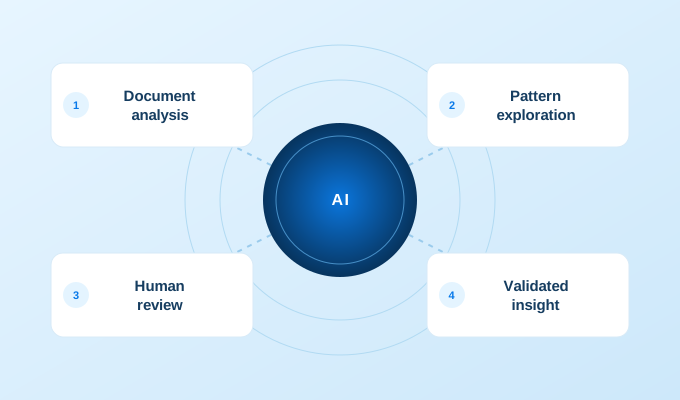
These connected elements help frame the work and the people it is intended to support.
AI can help teams work through large and varied collections of information. The value comes from matching the method to the question, evaluating the output, and keeping scientific judgment with qualified people.
Define the scientific or regulatory question, intended users, data sources, and limits of the analysis.
Use suitable tools to extract concepts, summarize literature, or surface patterns for further investigation.
Check outputs against source material, assess uncertainty, and document errors or gaps.
Place findings in context for subject matter experts, who retain responsibility for interpretation.
Activities are shaped around the mission, the available evidence, and the needs of the people doing the work.
Use-case assessments, source-linked evidence summaries, validation notes, and governance recommendations.
AI-assisted work should be designed around a specific question and the people who will evaluate the results. The right approach depends on the available data, the consequences of error, and the review environment.
Identify concepts, compare themes, and develop draft summaries from large collections of scientific literature or regulatory materials. Source references and reviewer checks help make the results traceable.
Use analytical tools to highlight patterns in adverse event reports or other datasets for further investigation. A potential pattern is a starting point for expert assessment, not a conclusion by itself.
Document intended use, data limitations, validation methods, and responsibilities. Assess outputs for accuracy, omissions, and appropriate use before incorporating them into a workflow.
A team exploring an emerging safety topic could define a question, gather relevant sources, use approved tools to organize potential themes, and have subject matter experts verify each finding against the underlying evidence.
Agentic AI can coordinate defined tasks across approved information and tools. In health and regulatory settings, these workflows need clear permissions, traceable evidence, testing, and human checkpoints appropriate to the work.
Explore agents that help identify data quality issues, organize metadata, flag inconsistent terminology, and prepare proposed mappings for review by data specialists.
Coordinate searches across permitted scientific literature, guidance, and internal knowledge sources; assemble source-linked summaries for expert validation.
Assist with organizing materials, tracking outstanding questions, and drafting review support documents while keeping scientific and regulatory decisions with authorized people.
Assess opportunities for agents to work across approved systems, retrieve relevant information, and propose next steps within defined interfaces and access boundaries.
Help route analytical requests, gather appropriate data and context, and prepare reproducible analysis plans or draft outputs for qualified reviewers.
Define permitted actions, test accuracy and reliability, document source provenance, and monitor outcomes with escalation and human approval points.
Specify the objective, approved data, tools, and access.
Find relevant information from permitted sources.
Organize evidence and suggest a reviewable next step.
Validate outputs and approve consequential actions.
Illustrative applications depend on project requirements, approved technologies, data permissions, and appropriate safeguards.