CDISC SDTM, ADaM & SEND
SDTM organizes study tabulation data; ADaM supports analysis datasets and traceability; SEND structures nonclinical study data. CDISC also provides a broader family of clinical research standards.

Apply scientific and data-driven methods to help teams understand clinical, nonclinical, and other health evidence.
We bring a thoughtful, multidisciplinary approach to the needs of public-sector teams and the people they serve.
Support analytical questions with well-documented approaches to clinical and nonclinical data.
Use statistical programming and visualization approaches to develop analysis-ready data and clear outputs.
Bring together data from different studies or sources for consistent analysis.
Assist with scientific investigations, evidence synthesis, and interpretation of results.
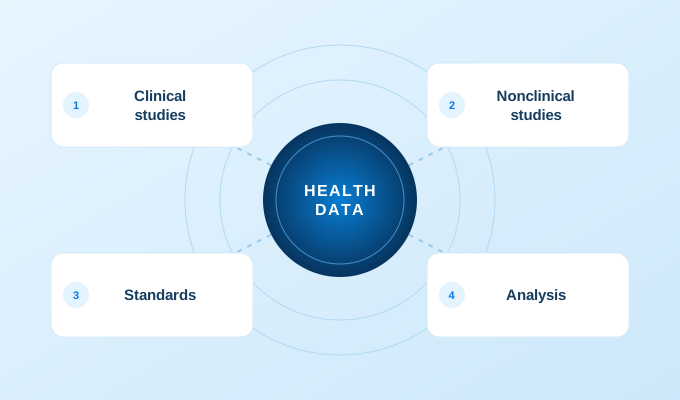
These connected elements help frame the work and the people it is intended to support.
Health data science combines subject matter understanding, reproducible analysis, and careful interpretation. Each stage helps reviewers understand both what the evidence shows and where uncertainty remains.
Define the research question, relevant populations, data sources, and limitations.
Curate, harmonize, and document clinical or nonclinical datasets.
Apply statistical methods, programming, visualization, or simulation appropriate to the question.
Review results, assess assumptions, and communicate findings in context.
Activities are shaped around the mission, the available evidence, and the needs of the people doing the work.
Data dictionaries, analysis plans, reproducible scripts, tables and figures, and scientific summaries.
Standards, models, terminologies, and dictionaries serve different roles. Together they can help teams structure, exchange, interpret, and analyze health and study data. The applicable standard and version depend on the use case and agency requirements.
SDTM organizes study tabulation data; ADaM supports analysis datasets and traceability; SEND structures nonclinical study data. CDISC also provides a broader family of clinical research standards.
HL7 develops standards for the exchange and integration of health information. The Clinical Document Architecture (CDA) specifies the structure and semantics of clinical documents.
The Observational Medical Outcomes Partnership (OMOP) Common Data Model provides a standardized structure and vocabulary approach for observational health data analysis.
LOINC identifies health measurements, observations, and documents. SNOMED CT provides clinical terminology for representing health concepts.
MedDRA is a medical terminology used in regulatory activities. ICH E2B XML R2 and R3 provide formats for electronic exchange of individual case safety reports.
ISO publishes standards used across many domains; IDMP is a set of ISO standards for identification of medicinal products. The FAERS Product Dictionary and WHO-Drug provide product and drug terminology resources relevant to safety information.
The supplied draft statement of work identifies these standards and resources except OMOP, which was added at your request. Standards selection and implementation should be confirmed for the specific project. FDA Study Data Standards Resources ↗
Health datasets can vary by study, population, terminology, and purpose. Thoughtful preparation and transparent methods help teams use that information responsibly.
Review source formats, metadata, variables, and terminology. Document cleaning, transformations, and assumptions so a dataset can be understood and reused.
Support statistical programming, tables, listings, figures, simulations, and exploratory analyses using methods suited to the question and the available data.
Connect analytical findings with relevant literature and domain knowledge. Describe limitations, uncertainty, and areas requiring additional scientific review.
For an analysis spanning several studies, support could begin with a review of data definitions and quality, followed by harmonization, reproducible analysis, and visual summaries for subject matter experts.